







To the readers and future authors of the journal

ISSN 2408-9176 (Online)
ISSN 2312-7899 (Printed)
 "ΠΡΑΞΗΜΑ" is included in the Scopus database
The publisher of this scientific journal is Tomsk State Pedagogical University (Russia, Tomsk).
Dear colleagues!
The journal "ΠΡΑΞΗMΑ. Journal of Visual Semiotics" ("PRAXEMA") is a journal dedicated to the discussion of theoretical problems of modern visual semiotics, which includes the study of the visual aspects of the organization and functioning of culture as a communicative environment.
Visual semiotics is understood as one of the new dynamic human sciences and as a multidisciplinary field in which methods and achievements of traditional branches of the humanities interact: philosophy, cultural studies, sociology, political science, art history, religious studies, esthetics, ethics, history, linguistics, and ethnography.
The emphasis on the communicative aspects of visual semiotics determines the dominant research perspective on this topic. It offers the possibility to focus on the relationship between visual phenomena and systems of visual phenomena and cultural and anthropological practice. In this (pragmatic) perspective, every visual sema can and should be interpreted as a praxema: a sign representing and producing certain pragmatic installations, norms, and effects. The object of visual semiotics is thus understood as a sphere of cultural and anthropological praxis, a space of mutual understanding and interaction through visually expressed, existentially important meanings.
Frequency: 4 issues per year.
Articles on the following topics can be published in the journal:
- philosophy of the visual image (semantics, syntax, pragmatics)
- theory of the sign and sign communication; visual (non-verbal) languages
- visual axiology (analysis of the visual experience of the fixation and translation of norms and values in culture; cultural and semiotic transfer; visual environment as a field of normative didactics; visual semiotics as communicative axiology)
- visual anthropology (philosophical, ethnological, and sociological aspects of the representation of human identity)
- visual practices in cultures; visual aspects of the representation of cultural realities; visual arts in the life and history of cultures
- visual aspects of government policy and regional management
- semiotic diagnostics of social and cultural change; visual parameters of culture in relation to the tendencies of humanization/dehumanization of society
- visual semiotics and humanitarian knowledge; the visual aspects of modern Humanities (history, sociology, political science, archeology)
- visual aspects of government policy and regional management
- semiotics of photography
- semiotics of cinema
- semiotics of architecture
- semiotics and hermeneutics of the human lifeworld; anthropology of space
- visual aspects of the functioning of the media
- semiotics of games
- visual semiotics and esthetics
- visual semiotics and cultural geography
- visual aspects of pedagogy
- visual aspects and the dominance of cognitive practices
- visual and virtual
This list is not exhaustive and can be extended to other areas of visual semiotic research at the expense of attention. The languages of this journal are Russian, English and French. For publication in the journal, the editorial board accepts contributions in the following genres: scientific article, translation of a scientific article, essay, interview, review, bibliographic review, and report on a scientific event. All submitted materials will be reviewed.
The founder of this scientific journal is Tomsk State Pedagogical University (Tomsk, Russia).
The journal is included in the subscription catalog of "Russian Press" Index: 90129.
News
We announce the topic of Issue 4 of the journal in 2026: "Texts in Modern Education: Hybrid Genesis and Hybrid Forms".
Publication date: Monday, 24 November 2025
On November 20, the International Scientific and Practical Conference "Education in Texts and Text in Education" was held at Lomonosov Moscow State University. Among the papers presented was I.V. Melik-Gaikazyan's paper, "Semiotic Optimum: Between Hybrid Genesis and Hybrid Forms".
“Initially, this concept < the author's proposed concept of the "semiotic optimum"> captured the general form of a solution to a methodological task under conditions of sudden (e.g., quarantine) changes in the circumstances of the educational process. In other words, the rapid development of a course structure where the main content would correspond to the teaching goals, and its form would assume the required appearance. Thus, the optimum is a palliative reaction to external circumstances from the standpoint of one's own goals, understood in a specific way. This optimum is deemed "semiotic" because it focuses on finding an effective syntax between the symbolic expression of transformation goals and the semantic-pragmatic expression of the goals of teaching itself”. [Melik-Gaykazyan I. (2025). "Semiotic optimum": Genesis of discovered situations. Vestnik Tomskogo gosudarstvennogo universiteta. Filosofiya. Sotsiologiya. Politologiya – Tomsk State University Journal of Philosophy, Sociology and Political Science, 88]
Discussion of this paper during the conference and afterward led to the formulation of the announced topic. Submissions for Issue 4 will be accepted until July 20, 2026. This issue will contain only 8-10 articles, so we invite you to submit an abstract of your article in Russian by May 1, 2026 (praxema@tspu.ru, subject line: "Issue 4"). According to the journal's accepted formatting guidelines, this abstract presents the purpose of the study, the sequential solution to the problems, the approaches and methods used, the main results of the study, and the scientific significance of these results. The abstract should be between 2,500 and 3,000 characters long, excluding spaces.
Request to Update Domain and Email Information for ΠΡΑΞΗMΑ. Journal of Visual Semiotics
Publication date: Thursday, 19 December 2024
Dear Colleagues,
We would like to inform you that our scientific journal, Tomsk Journal of ΠΡΑΞΗMΑ. Journal of Visual Semiotics, has updated its domain name.
The domain has changed from https://praxema.tspu.edu.ru/ to https://praxema.tspu.ru/.
Currently, both web addresses are operational. However, as of December 25, 2024, the domain https://praxema.tspu.edu.ru/ will no longer be active.
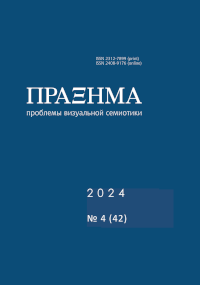
The current issue of "ΠΡΑΞΗMΑ. Journal of Visual Semiotics" (issue 4) has been published.
Publication date: Monday, 16 December 2024
The journal "ΠΡΑΞΗΜΑ" is included in the Scopus database.
Publication date: Monday, 25 June 2018
Dear readers and authors, the journal "ΠΡΑΞΗΜΑ" has been included in the Scopus database since 2018.Now "ΠΡΑΞΗΜΑ. Problems of Visual Semiotics" is included in the Ulrich's Periodicals Directory database.
Publication date: Saturday, 25 October 2014
Now "ΠΡΑΞΗΜΑ. Problems of Visual Semiotics" is included in the Ulrich's Periodicals Directory database.
Regular journal reviewers
Согласие на обработку персональных данных PRAXEMA
Согласие на обработку персональных данных
Пользователь, передавая свои персональные данные, обязуется принять настоящее Согласие на обработку персональных данных (далее — Согласие). Принятием (акцептом) оферты Согласия является регистрация на сайте или предоставление персональных данных в форме подачи заявки на регистрацию (или иное название формы), размещенных на сайте. Пользователь дает свое согласие ТГПУ, которому принадлежит сайт журнала "ΠΡΑΞΗΜΑ. Проблемы визуальной семиотики" (praxema.tspu.ru) и которое расположено по адресу: г. Томск, ул. Киевская, 60 , на обработку своих персональных данных со следующими условиями:
- Данное Согласие дается на обработку персональных данных как без, так и с использованием средств автоматизации.
- Согласие на обработку персональных данных Пользователя дается только и исключительно с целью публикация передаваемых статей в научном журнале "ΠΡΑΞΗΜΑ".
- Основанием для обработки персональных данных являются: ст. 6 Федерального закона №152-ФЗ «О персональных данных», иные федеральные законы и подзаконные акты.
- В ходе обработки с персональными данными будут совершены следующие действия: сбор, запись, систематизация, накопление, хранение, уточнение (обновление, изменение), извлечение, использование, передача (распространение, предоставление, доступ), обезличивание, блокирование, удаление, уничтожение — все упомянутые варианты только в целях, указанных в п. 2 настоящего Согласия.
- Передача персональных данных третьим лицам осуществляется на основании законодательства Российской Федерации, договора с участием субъекта персональных данных или с его согласия.
- Персональные данные обрабатываются до завершения всех необходимых процедур. Также обработка может быть прекращена по запросу субъекта персональных данных. Хранение персональных данных, зафиксированных на бумажных носителях, осуществляется согласно Федеральному закону № 125-ФЗ «Об архивном деле в Российской Федерации» и иным нормативно-правовым актам в области архивного дела и архивного хранения.
- Согласие может быть отозвано субъектом персональных данных или его представителем путем направления письменного заявления в ТГПУ или его представителю по адресу, указанному в начале данного Согласия.
- В случае отзыва субъектом персональных данных или его представителем Согласия на обработку персональных данных, ТГПУ вправе продолжить обработку без разрешения субъекта персональных данных при наличии оснований, указанных в пунктах 2 — 11 части 1 статьи 6, части 2 статьи 10 и части 2 статьи 11 Федерального закона №152-ФЗ «О персональных данных» от 26.06.2006 г.
- Настоящее Согласие действует все время до момента прекращения обработки персональных данных по причинам, указанным в п. 9 данного документа.
Согласие на обработку персональных данных PRAXEMA (2)
Consent to Personal Data Processing
By submitting his/her personal data the user gives consent on processing his/her personal data (hereinafter – Consent). By registration on the web-site or by submitting his/her personal data in a form of registration application (or another form) provided by the web-site one gives the Consent on personal data processing. The user gives his/her Consent to the processing of his/her personal data by TSPU (TSPU address: Tomsk, 60 Kievskaya Street), the authorized owner of the web-site of SCEINTIFIC MAGAZIN “ΠΡΑΞΗMΑ. Journal of Visual Semiotics” (praxema.tspu.edu.ru), in accordance with the flilowing conditions:
- This Consent is given to the processing of personal data with and without usage of automation means.
- The Consent to the processing of personal data is given only with purpose of subscription to “TSPU Bolletin”.
- The personal data is processed on the grounds of: article 6 of the Federal law №152 «On personal date», other Federal laws and subordinate legislation.
- The flilowing actions will be dome with personal data during processing: clilection, record, systematization, storing, specification (updating, editing), extraction, usage, depersonalization, blocking, removal, destruction, transmitting, distribution – within the goals mentioned in paragraph 2 of this Consent.
- Published personal data becomes accessible and available on the corresponding open Internet site.
- Transmitting of personal data to the third parties is executed on the grounds of the Russian Federation legislation, an agreement with the subject to personal data or with his consent.
- Personal data is processed until all the necessary procedures are executed. The processing can be also abrupt by the request of the subject to personal data. The storage of personal data in hard-copy form is executed according to the Federal law № 125 «On records in Russian Federation» and other regolatory legal act on records and records storage. Consent may be cancelled by the subject to personal data or by his/her representatives by sending of written application to TSPU of its representative to the address mentioned in the beginning of this Consent.
- In case of cancellation of personal data processing by the subject to personal data or his/her representative, TSPU has a right to continue processing without user’s consent given grounds stated in paragraphs 2-11, part 1 of article 6, part 2, article 10, part 2, article 11 of the Federal law №152 “On personal data” dared 26.06.2006.
- This Consent Remains valid up till the end of personal data processing according to the grounds mentioned in paragraph 9 of this document.
The principles of publishing ethics
THE PRINCIPLES OF PUBLISHING ETHICS
The Editorial Board of “ΠΡΑΞΗΜΑ. Journal of Visual Semiotics” strictly adheres to publishing ethics standards and strives to prevent possible violations of such.
Publishing ethics is understood as a set of basic principles that organize the Editorial Board’s professional activities during the selection of publications, presentations and the distribution of scientific materials.
The journal’s Editorial Board does all necessary to respect ethical provisions as established in the international research community, and to prevent violations of these provisions both in its own activity and in relations with all the participants of the scholarly publication process, including the authors, reviewers, editors, publishers, distributors, and readers.
All authors are equal in their right to publish in the journal. Incoming material is sent for review, subject to the author following the previously published guidelines for submitting papers.
Material is accepted for publication on the basis of positive feedback of a reviewer (reviewers). The Editorial Board reserves the right to reject a paper in the case of violation of publication guidelines, or based on a justified negative review of at least one reviewer.
The author is responsible for the authenticity of the submitted information and assertion. The information presented in the text should be accompanied by references to the source.
The author, having submitted the paper to the Editorial Board, ensures that his work is original, has not been given to the editors of other publications, and that all possible conflicts of interests related to copyright are settled.
Any manuscripts received for review must be treated as confidential documents. They must not be shown to or discussed with others except for the authors, reviewers and the publisher. Unpublished materials disclosed in a submitted manuscript must not be used in other research without the express written consent of the author.
The Editorial Board, adhering to standards of academic ethics, protects the reputation of the authors and considers all cases of plagiarism seriously. Plagiarism violates the rights of authors; accusations of plagiarism have a negative impact on a researcher’s career. Under these circumstances, the Editorial Board uses a system of procedures to adequately respond to accusations of plagiarism.
In order to ensure objectivity, the Editorial Board thoroughly examines each case of plagiarism and considers the arguments of all interested parties. The Editorial Board tends to get the most accurate information from the authors disputed publication or copyright holders and examines it before giving conclusions and taking concrete actions. The decision of the Editorial Board is impartial, objective and not susceptible to external influence.
The Editorial Board reserves the right not to respond to accusations of plagiarism, if the prosecutor provides false information about themselves or acts in an unethical or threatening manner. The Editorial Board is not obliged to discuss cases of plagiarism with persons who have no direct relation to it.
The Editorial Board takes reasonably responsive measures when ethical or legal complaints have been presented concerning a submitted manuscript or published paper, including the publication of rectifications, explanations and apologies.
Due to the public nature of knowledge and freedom of critical thinking inherent in the process of scientific and philosophical research, judgments and conclusions of a controversial nature and style are permissible in published authors’ materials.
Biased opinion or abuse is not allowed by the Editorial Board members and reviewers in their professional activities.
The Editorial Board should evaluate manuscripts for their intellectual content without regard to race, gender, religious belief, ethnic origin, citizenship, or political philosophy of the authors. Personal criticism of the author is inappropriate.
The chief editor is responsible for the scientific quality of published papers, provides an objective process of review and makes decisions on controversial issues. These decisions are independent of commercial interests and personal bias.
The Editorial Board’s activities are focused primarily on openness and unbiased reporting.
The editors of the journal generally subscribe and make honest attempts to adhere to the Code of Conduct of COPE (Committee On Publication Ethics).
Contacts
Certificate | PI № FS 77 - 57493 |
Title | PRAXEMA. Journal of Visual Semiotics |
Registration | 27.03.2014 |
Form | print media magazine |
Territory | Russian Federation, foreign countries |
Founders | Federal State Budgetary Educational Institution of Higher Education «Tomsk State Pedagogical University» |
Address | pr. Komsomolsky 75, office 319, Tomsk, Russian Federation, 634041 |
praxema@tspu.ru | |
Languages | Russian, English, French |
Subcategories
News
News